

Woman wearing the HALO Phoenix dedicated eclipse overlay in an olive-tree courtyard

Direct solar viewing

For the extraordinary days.

A dedicated magnetic overlay for totality, designed as part of the Phoenix system and tested for direct observation of the Sun.
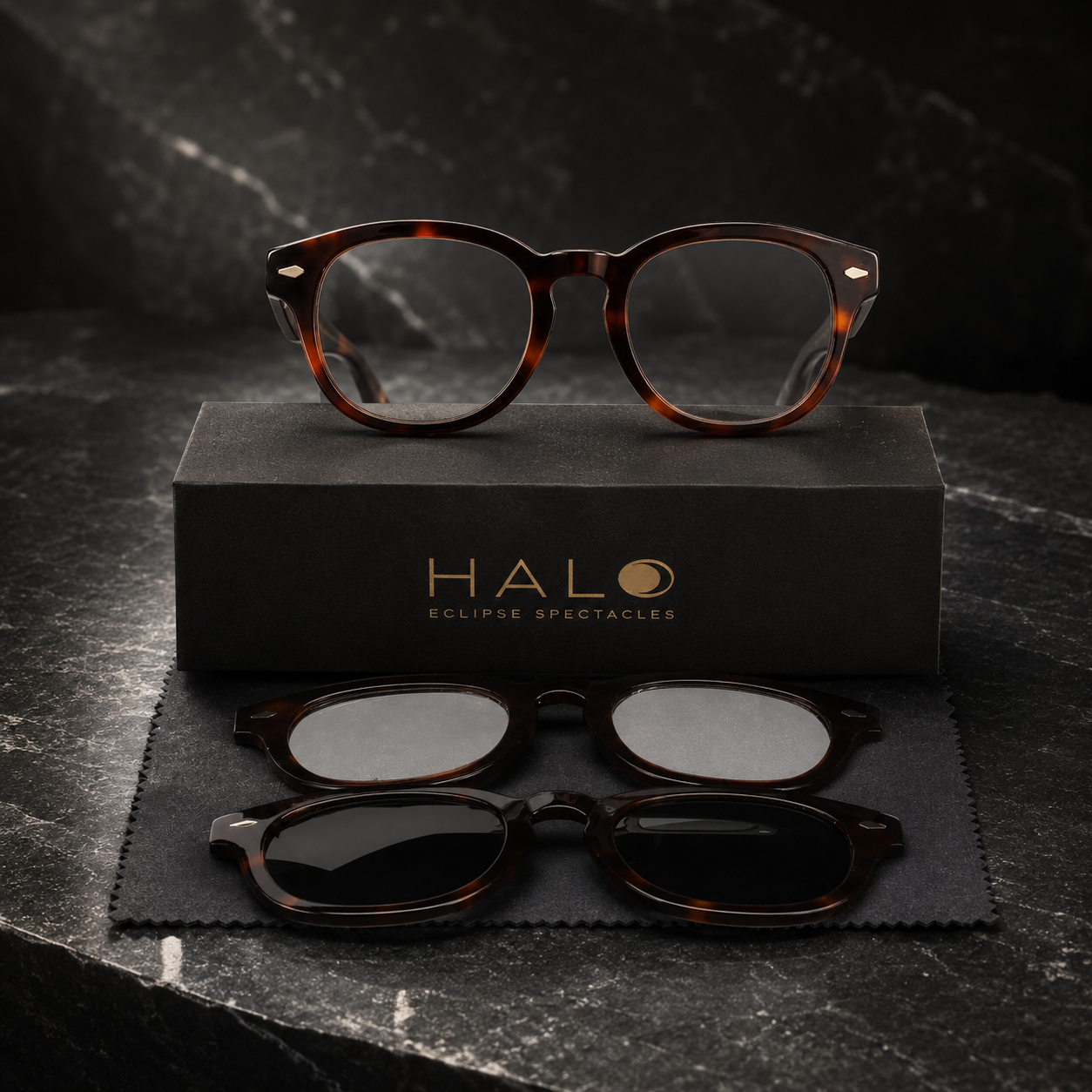
HALO Phoenix clear base frame with polarized sun and dedicated eclipse overlays

Three distinct lenses

Each one has a different job.

Clear base lenses

The everyday base lens fitted inside the acetate frame. It is not safe for direct solar viewing.

Polarized sun overlay

A magnetic dark overlay for ordinary daylight and everyday sunglass wear. It is not safe for looking at the Sun.

Dedicated eclipse overlay

The silver solar-viewing overlay meets ISO 12312-2 and is the only Phoenix lens intended for direct observation of the Sun.

The purchasable Phoenix configuration includes one acetate frame, the clear base lenses, both magnetic overlays, a felt-lined hard case, microfiber cloth, and a quick-start viewing guide.

The eclipse system

One connection. Two finishes.
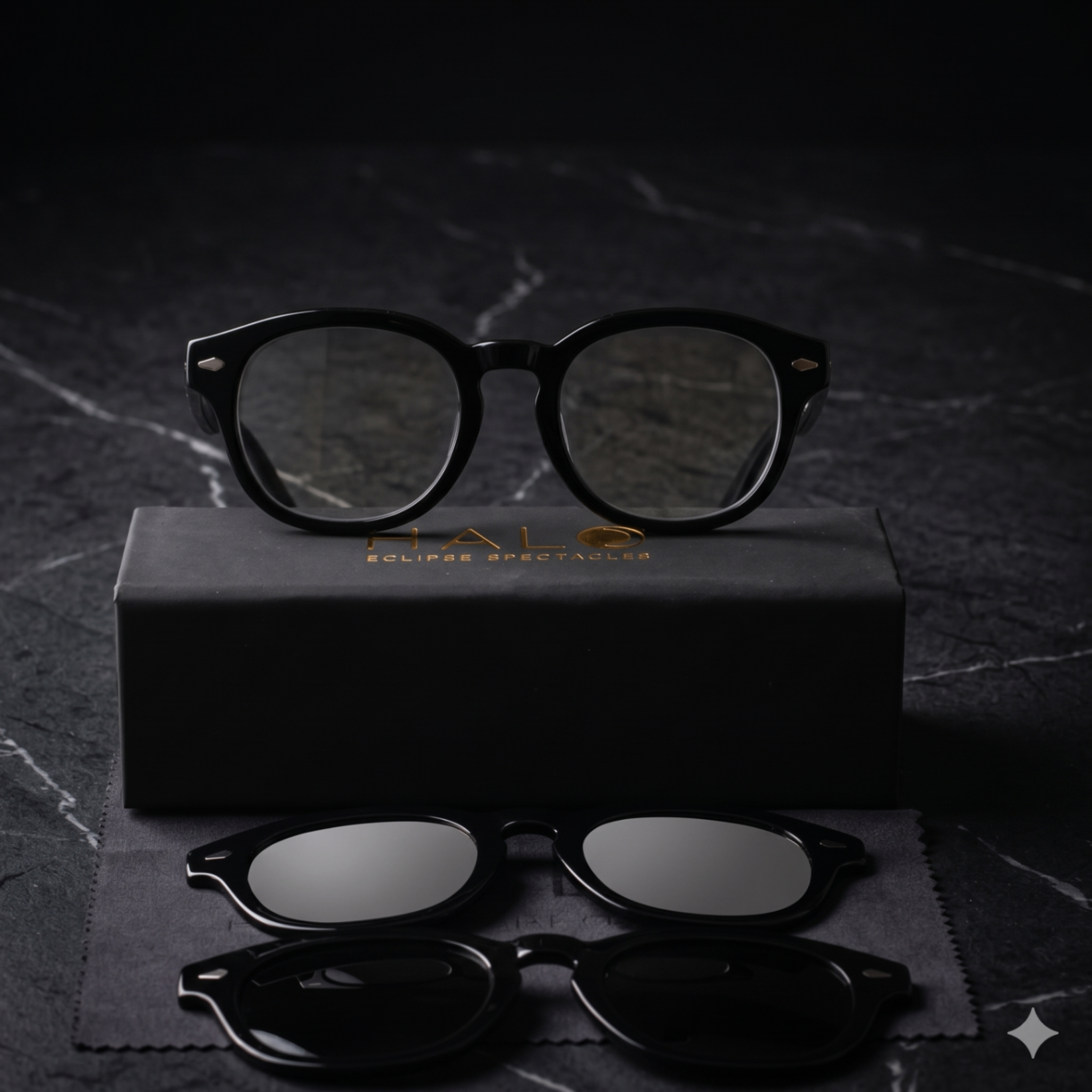
HALO Phoenix Noir with the silver dedicated eclipse overlay fitted
Phoenix Noir · Eclipse overlay
HALO Phoenix Tortie system with its magnetic overlays
Phoenix Tortie · Complete system
See it worn

Watch the connection.

The magnetic overlays align to the Phoenix frame by hand. The polarized sun overlay is for ordinary daylight; the dedicated eclipse overlay is for direct solar viewing.

Only the dedicated eclipse overlay meets ISO 12312-2 for direct solar viewing.

Safety and testing

Verify before you view.

The eclipse overlay meets ISO 12312-2:2015. Independent testing was performed by ORLAB at UNSW Sydney. Report 23203.1 covers the tortoiseshell sample; report 23203.2 covers the gloss-black sample.

The AAS publishes a supplier list; it does not certify products. HALO does not claim NASA endorsement.

Before every use: inspect the eclipse overlay for scratches, punctures, tears, or separation from its frame. Do not use a damaged overlay. Supervise children. Never use the clear or polarized lenses for direct solar viewing, and never look through a camera, telescope, or binoculars while wearing the eclipse overlay.

August 2, 2027

The next path to totality.

The August 2, 2027 total solar eclipse crosses southern Spain and North Africa, including Egypt, before continuing across the Arabian Peninsula.

  • Aug 2, 2027TotalLuxor · Southern Spain · North AfricaUp to 6m 23s
  • Jan 26, 2028AnnularGalápagos · Amazon Basin10m 27s
  • Jul 22, 2028TotalSydney · New Zealand5m 10s
  • Jun 1, 2030AnnularHokkaido · Russia5m 21s

Durations are path maxima; viewing duration varies by exact location.

Eclipse questions

Use the right lens.

When is the next total solar eclipse?
The next total solar eclipse is August 2, 2027. Its path of totality crosses southern Spain, North Africa—including Egypt—Saudi Arabia and Yemen. If you're traveling for totality, we recommend ordering HALO well in advance. Tracked U.S. and international shipping options are available.
Can I get prescription lenses in place of the blue-light lenses?
Yes. Any optician or lens exchange company can glaze the base frames with your prescription. The magnetic eclipse and sunglass lenses attach to the frame itself, so they snap on over any base lens. You get your prescription full-time, plus eclipse and sun protection when you need it. The standard base lens is a blue-light lens; prescription glazing replaces it, and your optician can add a blue-light coating to keep that benefit.
Are the glasses safe for direct solar viewing?
The eclipse lens meets ISO 12312-2, the international standard for direct solar viewing, and blocks more than 99.996% of visible light along with all harmful UV and infrared. The lens is made by a manufacturer on the AAS Suppliers of Safe Solar Viewers & Filters list and is independently tested by ORLAB at UNSW Sydney; read the report here. Only the eclipse lens is rated for looking at the sun. The polarized sunglass and blue-light lenses are for everyday wear and must never be used to view the sun.
What's included in the box?
One Phoenix frame in recycled hand-polished acetate, three lenses (a blue-light lens, a magnetic polarized UV400 sunglass clip-on, and a magnetic ISO 12312-2 eclipse clip-on), a felt-lined hard case, a microfiber cloth, and a quick-start viewing guide.
How do the lenses swap?
The sunglass and eclipse lenses are magnetic clip-ons that snap onto the front of the frame, over the blue-light lens. They change in a second, by hand, no tools.

The eclipse overlay is part of Phoenix.

Explore the complete frame, choose your finish, and continue through the existing HALO purchase flow.

View Phoenix